Friday, February 25, 2022

Review: Anti-Semitism and/or Racism are the Themes of Solo Show “Just for Us,” Experimental “Black No More” and a Modern “The Merchant of Venice”

Theater Review:  Just for Us, Black No More, The Merchant of Venice


Just for Us (c) Monique Carboni

Theater: Just For Us 
Soho Playhouse (reopening on March 14) 


Alex Edelman is a young comedian who thinks he can make the leap to comedic monologist, a la Mike Birbiglia, Hannah Gadsby and Sandra Bernhard. It’s not an easy leap. Being funny is one thing, but a successful solo play has to skillfully incorporate the jokes to create an arc around a central narrative, while also making the audience think a little. Edelman has a few hiccups along the way, but his newest show, “Just For Us,” is a delightful home run (having Birbiglia as your mentor doesn’t hurt). I didn’t see his earlier shows, “Millennial” or “Everything Handed to You,” but the reason this show will be his calling card from here on out is because he has a gem of a hook: What if a Manhattan Jew attended a white supremacist meeting in Queens? Edelman’s delicious variation on the plot of Spike Lee film “BlacKkKlansman,” however, doesn’t really come into play until the second half. For the first half, he gives us a pretty succinct autobiography of his Orthodox Jewish upbringings in Boston with his Olympic athlete brother (in skeleton sledding of all things) before launching into how he saw a tweet about the meeting and why he decided to go. I’m specifically not divulging too many details because you should experience Edelman’s easygoing storytelling yourself. I wish he trusted his material enough to not have some audience participation moments (although I did guess the singer of a recording and yelled it out the night I went), and the story about that recording could have used more parallels to the main story about being an outsider in a homogenized group. But he and director Adam Brace do a wonderful job creating this world with only a mic stand, three stools and a surprise prop in Edelman’s pants. But I may have said too much already. 

Wednesday, February 23, 2022

Review: Singer Troye Sivan is a Romantic Rebel in Terrific “Three Months”


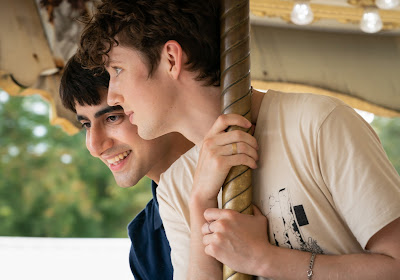
Three Months (c) MTV Entertainment Studios


Film Review: Three Months 
Streaming on Paramount+ 


Premise: It is 2011 and Caleb (Troye Sivan) is working at a mini-mart in Florida the summer after high school. His summer is overshadowed by the fact that when he had sex with a man he just met at a bar, the condom broke. His doctor (Javier Muñoz) tells him he has to wait three months in order to know if he has HIV, so over the course of the summer, we follow the ups and downs of Caleb’s chaotic life. His father is dead and his mother (Amy Landecker) has re-married an Orthodox man who doesn’t approve of his gay life, so he now lives with his doting grandmother (Ellen Burstyn) and her surly paramour (Louis Gossett, Jr.). He works at the mart with his best friend, Dora (Brianne Tju), who enjoys flirting with their boss (Judy Greer). Caleb also meets Estha (Viveik Kalra) at an LGBT support group. Their puppy dog flirtation could lead to something, but Caleb can’t seem to shake the looming results of his HIV status. Estha is also from India and closeted, which complicates things even more. 

Tuesday, February 22, 2022

Nicolas Cage, Tessa Thompson & The Power of the Dog receive LGBTQ Critics Dorian Award Nominations


Flee (c) Neon, Participant

The Power of the Dog, Flee, Passing and West Side Story Dominate Dorian Award Nominations


Adding some zest to the film awards season, GALECA: The Society of LGBTQ Entertainment Critics has announced its Dorian Award nominations for the best in movies, mainstream to LGBTQ. Jane Campion’s volatile period drama "The Power of the Dog" leads the pack with nine nods, including for best film, LGBTQ film, director and three for acting. Coming in a few rungs lower with five nominations each: The 1920s-set racial drama "Passing," the unusual animated refugee documentary "Flee," and Steven Spielberg’s vibrant reimagining of "West Side Story."  "Dog" and "Story" contend for Best Film along with three films that received four Dorian nominations each in all: The bittersweet Japanese relationship drama "Drive My Car," Norway’s acerbic romantic comedy "The Worst Person in the World" and "Tick, Tick. . .Boom!," the poignant musical about the too-short life of Rent creator Jonathan Larson.

Monday, February 21, 2022

Oscar Predictions - February 2022

The Interested Bystander's Oscar Predictions (Ranked)


The Power of the Dog (c) Netflix


After a couple of weeks of sitting with the nominations, here are my rankings of who I think is going to win, before the other awards (SAG, CRITICS CHOICE, DGA, PGA) are announced.  And while Timothee Chalamet was in two of the nominated Best Pictures, so was Bradley Cooper.   So you can call these the Timmys or the Coops.


BEST PICTURE 

The Power of the Dog 
Belfast 
CODA 
Dune 
West Side Story 
King Richard 
Licorice Pizza 
Don’t Look Up 
Nightmare Alley 
Drive My Car 

Friday, February 18, 2022

Reviews: Pablo Larraín, Oscar Isaac and Andrew Garfield’s Other 2021 Films

Film Reviews: Ema, The Card Counter, Mainstream 


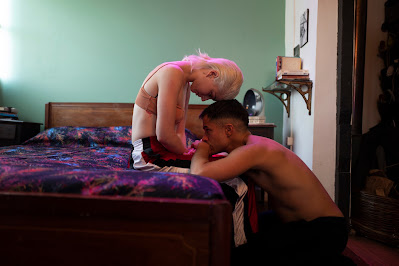
Ema (c) Music Box Films


Film: Ema 
On Showtime, streaming and Blu-Ray 


Pablo Larraín had two films released in 2021 in the U.S. “Spencer” is probably his most high-profile, but “Ema” might just be the most experimental of his career. The movie made its debut at the Venice Film Festival in 2019, and after opening in most of the world since, it finally made its post-pandemic debut in U.S. cinemas last fall. Ema (Mariana Di Girolamo) is a dancer in her husband Gaston’s (Gael Garcia Bernal, in his most mature role to date) dance company in Chile. But at the start of the movie, she is being shunned by everyone for deciding to abandon her adopted son Polo and return him to the foster care system after a tragic accident. The movie’s tone feels like a poetic mix of directors Lynne Ramsey and Gapser Noe. Everything feels surreal, even though the central theme of guilt and placing blame is very real and permeates the film. Is Ema becoming unhinged in the aftermath of giving up Polo? Her relationship with Gaston borders on emotional sadomasochism and her sexual experimentations wouldn’t feel out of place in the movie “Titane” (to be fair, Ema doesn’t go so far as to sleep with a car). Most of the time I didn’t understand what was going on in this bizarre landscape that represents Ema’s emotional state, but Larraín kept me on my toes, so I couldn’t look away, whether from the fire imagery or random dance interludes that punctuate scenes. It all sort of gets explained by the film’s end, and whether it’s satisfying or not depends on if you are on Ema and Larraín’s wavelength.